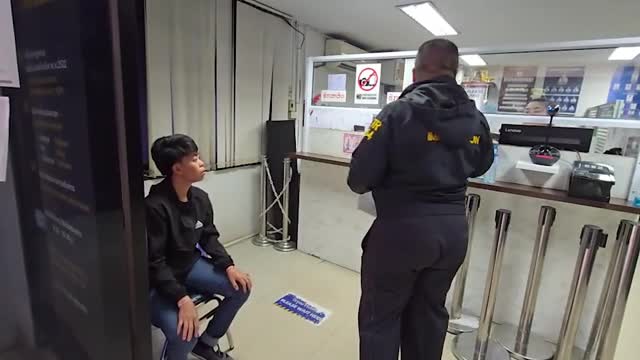
Thai police rescue Chinese female student in ‘virtual kidnapping scam’ linked to transnational fraud gang..


Thai police rescued a Chinese female student who allegedly staged her own kidnapping for a transnational fraud gang.
Wang, 21, was reportedly manipulated by the crime group into extorting money from her own father in Hong Kong.
The gang was said to have 'virtually kidnapped' the young woman by threatening to falsely implicate her in criminal activities if she refused to cooperate.
Police launched an investigation when Wang vanished shortly after arriving in Thailand on June 1.
Her father later received messages on WeChat from a man claiming she had been kidnapped, demanding 3 million HKD for her release.
The alleged kidnappers sent disturbing videos showing Wang with her hands and feet bound in rope, her shirt ripped, and her knee scraped.
But investigators found inconsistencies after reviewing CCTV footage, hotel records, and tracking Wang's movements.
They found she travelled alone, and that nobody had entered or left her hotel room.
CCTV footage reportedly showed her leaving in a taxi to buy ropes, a knife, body paint and red lipstick - believed to have been used to stage torture photos for ransom.
Police finally tracked her to another hotel near Bangkok on June 3, where she had reportedly checked in using a fake passport image supplied by the scammers.
Wang was rescued unharmed.
Officers said the gang had earlier tricked Wang's father into transferring 1.4 million HKD in 'overseas study expenses' before the elaborate plot was discovered.
The funds were later distributed through several mule accounts allegedly linked to the fraud operation.
They said Wang had fallen victim to a 'virtual kidnapping' operated by a transnational criminal network, in which scammers pose as government officials or law enforcement officers to convince victims they are implicated in crimes.
Police General Thatchai Pitaneelaboot, deputy national police chief, said the scheme has increasingly been reported across the globe.
He said: 'This case reflects an increasingly sophisticated form of transnational crime that relies on technology and psychological manipulation to deceive victims.
‘Although no physical abduction took place, the damage and fear experienced by the victim and her family were real.
‘In some cases, victims may be deceived into travelling to neighbouring countries, which increases the risk of human trafficking.
‘The Royal Thai Police will work closely with Hong Kong Police to pursue legal action against the call centre scam network while strengthening cooperation with foreign law enforcement agencies to prevent people from falling victim to these criminal groups in the future.'
In April, four Chinese nationals were arrested in Bangkok after allegedly staging the kidnapping of a 19-year-old woman, Tong, to extort 110,000 CNY from her father in China.
Tong and her boyfriend, You Rongshan, 29, were accused of faking her abduction and claiming she had been trafficked to Myanmar via Cambodia before police tracked her down to a rented house in Samut Prakan, near Bangkok, on April 16.
The suspects were detained and deported after eagle-eyed investigators traced Tong's whereabouts through her social media and hotel records.

Experienced news editor with a strong background in editorial planning, content review, headline writing, and fact-checking. Skilled in managing news coverage, ensuring accuracy, maintaining editorial standards, and delivering timely, engaging stories across digital platforms.
All Rights Reserved © 2026